
Child Care Subsidy Calculator
Trying to estimate childcare costs can feel frustratingly vague until you can put real numbers beside the question. That is exactly where a Child Care Subsidy Calculator becomes useful. Instead of relying on broad assumptions, you can test your income, your care hours, and your provider’s fees to get a practical estimate of what childcare may actually cost your family.
Our Child Care Subsidy Calculator helps Australian families estimate how much subsidy they may receive and what their likely out-of-pocket childcare costs could be. It is built as a planning tool, not as a final government assessment, so it works best when you use it to compare scenarios and understand how different CCS rules affect the result.
That matters because Child Care Subsidy is not based on just one number. It is shaped by your family income, your subsidised hours, the type of childcare you use, and your provider’s fees. If you want the full background behind the numbers, read our guide on How Child Care Subsidy is Calculated.
Important: This Child Care Subsidy Calculator provides estimates only. Actual Child Care Subsidy outcomes are determined by Services Australia based on your individual circumstances.
Where can you estimate your Child Care Subsidy?
Child Care Subsidy (CCS) Calculator
Enter your details to estimate your CCS rate, subsidised hours, and out-of-pocket costs. Results are a guide only.
Your estimate
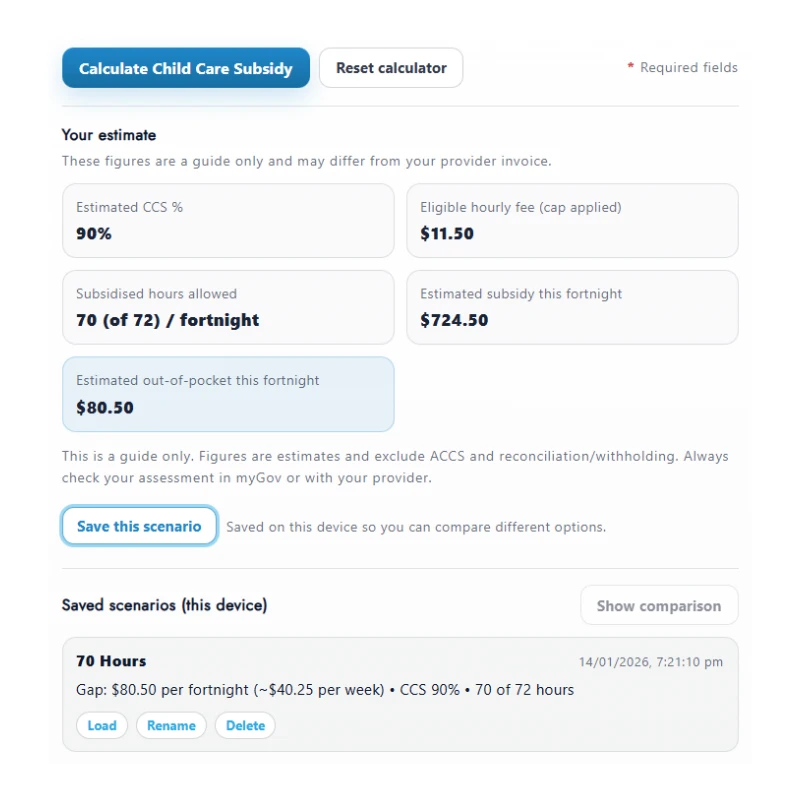
These figures are a guide only and may differ from your provider invoice.
This is a guide only. Figures are estimates and exclude ACCS and reconciliation/withholding. Always check your assessment in myGov or with your provider.
Saved scenarios (this device)
No saved scenarios yet. Calculate a result, then save it to see it here.
What can this Child Care Subsidy Calculator help you work out?
Families usually do not come to a calculator because they want a theory lesson. They come because they are asking practical questions: Can we afford three days? What happens if I return to work? Would a different centre make a real difference? This calculator is designed to help answer those planning questions.
Our Child Care Subsidy Calculator can help you estimate:
-
Your Child Care Subsidy percentage
-
The number of subsidised childcare hours
-
Your estimated out-of-pocket childcare costs
-
How changes to income, care hours, or provider fees may affect your result
It is especially useful when you are comparing childcare providers, planning a return to work or study, or checking whether a different attendance pattern could make your weekly budget easier to manage.
If your main question is how income changes the subsidy rate itself, our CCS Income Thresholds guide explains that side of the system in more detail.
How should you use the Child Care Subsidy Calculator?
The most helpful way to use the calculator is to treat it like a planning exercise. Start with the most realistic version of your current situation, then adjust one variable at a time. That gives you a much clearer sense of what is actually driving the result.
To get the most realistic estimate, enter information that reflects your expected circumstances for the financial year, not just what is happening this week.
How do you enter your family income?
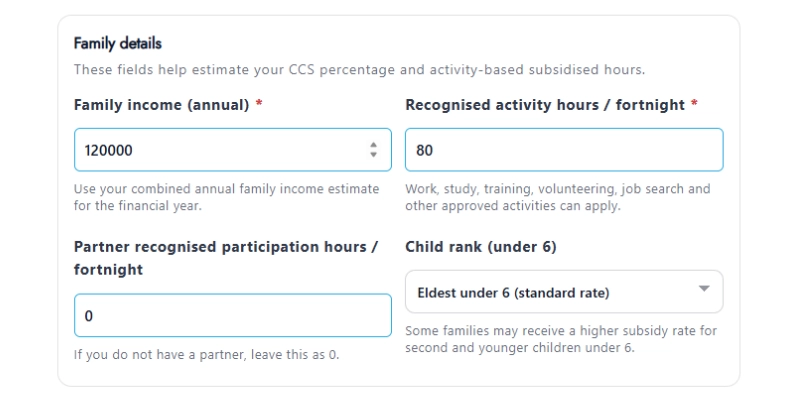
Use your combined annual family income, including both partners if applicable. This is one of the main inputs used to estimate your CCS percentage.
If your income is likely to change during the year, it is worth revisiting the calculator when that happens. A pay rise, fewer shifts, a return from leave, or moving into a new role can all change your likely out-of-pocket cost.
How do subsidised hours affect your calculator result?
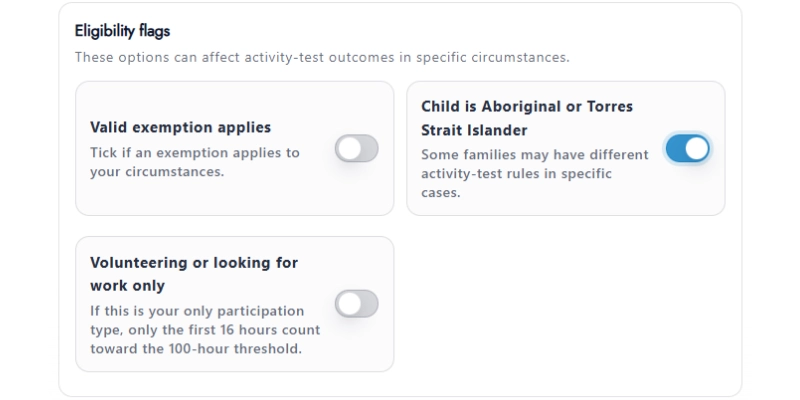
This is the part many parents underestimate. From 2026, CCS-eligible families can generally access at least a base level of subsidised care, with more hours available in some circumstances. In practical terms, the calculator is helping you test how much of your childcare use is likely to sit inside the subsidised range and how much could fall outside it.
Your subsidised hours do not set your CCS percentage, but they do shape how much of your childcare usage is likely to attract subsidy. That is why two families with similar incomes can still end up with very different out-of-pocket costs.
Why does the childcare service type matter?
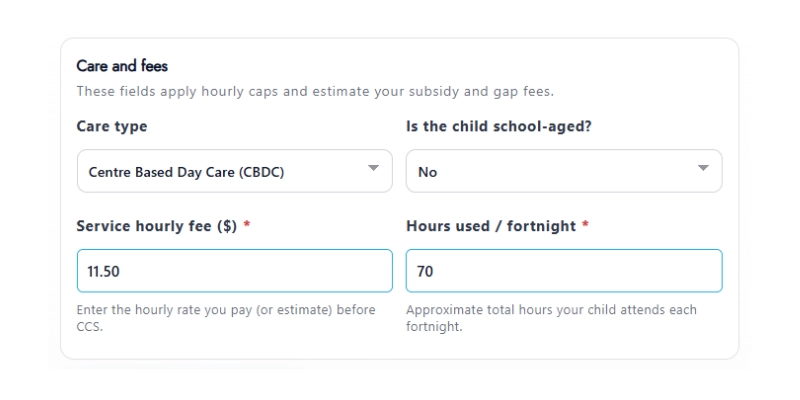
Different approved childcare service types can have different hourly rate caps. That matters because CCS applies to the lower of your provider’s hourly fee or the relevant government cap. So the type of care you choose can directly affect the estimate the calculator gives you.
Why do your provider’s fees matter so much?
Parents often assume that once they know their CCS percentage, they have the full story. In reality, provider fees can change the outcome dramatically. If your provider charges above the hourly rate cap, the amount above the cap is still paid by you. That is one of the biggest reasons a “good” subsidy percentage can still lead to a larger-than-expected gap fee.
How can comparing scenarios save you money?
Once you have entered your baseline details, the most useful next step is to change one factor at a time. That gives you a cleaner comparison and helps you see whether the bigger issue is income, provider fees, hours used, or the care pattern itself.
You might compare:
-
Different childcare providers with different fees
-
Different attendance patterns, such as part-time versus more regular care
-
Adding or removing a child from care
-
How a pay rise or drop in income may affect CCS
-
Whether a provider with fees closer to the hourly cap could reduce your gap fee
When you compare scenarios, focus on the difference between the results rather than treating any single estimate as exact. That is where a calculator tends to be most valuable.
How should you interpret your calculator results?
The calculator is most useful when you understand what each result is really showing. It is not promising what your exact invoice will be. It is showing how the main CCS settings may interact in your situation.
What does your CCS percentage mean?
This is the estimated portion of eligible childcare fees that may be subsidised. It is an important number, but it is not the whole story. A higher percentage does not automatically mean a low gap fee if your provider charges above the hourly rate cap.
What do subsidised hours mean in practice?
This reflects the amount of childcare use that may fall within your subsidised entitlement. If you use more childcare than the subsidised amount available to your family, the extra care is generally paid at the full fee.
What does the estimated out-of-pocket cost really tell you?
This is the figure many families care about most, because it is the number that feels real. It is your estimated share after the subsidy has been applied. Even so, it can still differ from actual invoices because providers structure fees differently, some charges sit outside CCS, and family details can change during the year.
What does a real calculator scenario look like?
Imagine a family with the following details:
- Combined family income: $110,000
- Two parents with regular work or recognised participation
- Long day care
- Provider fee: $14 per hour
The calculator may show:
- A CCS percentage lower than families on lower incomes
- A capped hourly subsidy amount
- A daily or weekly gap fee that is still meaningful
That result is not unusual. Even when CCS covers a solid share of eligible fees, a family can still pay a noticeable amount if the provider’s fees sit close to or above the hourly cap. This is one of the most common reasons parents feel their invoice is higher than they expected.
If that sounds familiar, our CCS Income Thresholds and How is CCS Calculated guides explain why that happens.
Why might your actual childcare bill differ from the calculator?
It is very common for calculator estimates and real invoices to differ. This does not usually mean the calculator is wrong. It usually means real childcare billing is more detailed than a planning estimate.
-
Some providers structure fees as daily session charges rather than clean hourly amounts
-
Additional charges may not be covered by CCS
-
Some childcare use may fall outside your subsidised hours
-
Income or family circumstances can change during the year
-
Different providers can sit very differently against the hourly rate cap
Understanding these differences helps you use the calculator as it is intended: a tool for planning, comparison, and better questions.
When should you use the calculator again?
Many families use a CCS calculator once, get a rough number, and move on. In practice, it is often more useful as an ongoing planning tool. It is worth revisiting whenever your circumstances change in a way that could affect your subsidy or childcare costs.
You may want to use the calculator again if you:
-
Change jobs or working hours
-
Start or finish study or training
-
Add or remove a child from care
-
Change childcare providers
-
Experience a meaningful change in family income
Regular reviews can help you spot changes early and update your official details through government channels before a small issue becomes an expensive surprise later.
What should families keep in mind before relying on a calculator result?
This calculator provides general information only. It is designed to help families plan, compare scenarios, and better understand how CCS may apply in real life. It does not replace an official assessment from Services Australia.
Actual Child Care Subsidy outcomes depend on individual circumstances, current government policy settings, and the details held in your official records. Always confirm important decisions through official CCS guidance.
Child Care Subsidy Guide is an independent information website and is not affiliated with the Australian Government.
What else should you read after using the calculator?
To make better sense of your result, explore these related guides:
Using the calculator alongside these guides gives families a much stronger understanding of both the estimate and the reasons real childcare costs can vary.
Child Care Subsidy Calculator – FAQs
Q: What is the Child Care Subsidy Calculator used for?
A: The Child Care Subsidy Calculator is used to estimate how much CCS a family may receive and what their likely out-of-pocket childcare costs could be based on income, subsidised hours, service type, and provider fees.
Q: How accurate is this Child Care Subsidy Calculator?
A: This calculator provides practical estimates based on current CCS settings, but final amounts may differ because Services Australia makes the official assessment and real provider billing can vary.
Q: What information do I need to use the Child Care Subsidy Calculator?
A: You will generally need your combined family income, likely subsidised hours, childcare service type, and the fees charged by your provider.
Q: Why might my gap fee still be high even with a good CCS percentage?
A: Your gap fee can still be high if your provider charges above the hourly rate cap or if some of your childcare use falls outside your subsidised hours.
Q: Why might my real childcare bill differ from the calculator result?
A: Real invoices can differ from calculator estimates because providers structure fees differently, some charges may not be covered by CCS, and family circumstances can change during the year.
Q: When should I use the calculator again?
A: It is worth using the calculator again when your income, work situation, childcare provider, attendance pattern, or number of children in care changes.
Reviewed: 12 March 2026